Introduction
The difference between useful AI output and garbage often comes down to how you ask. These prompt templates have been tested and refined for reliability engineering tasks. Copy them, fill in the blanks, and get useful results.
!Prompt Templates for Reliability Engineers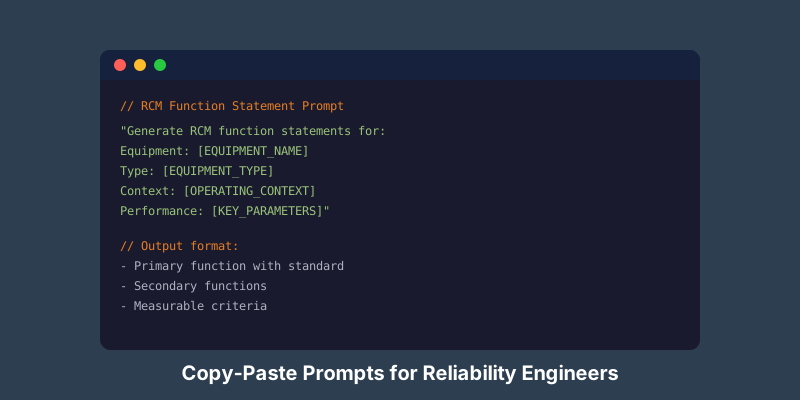
How to Use These Templates
- 1.Copy the template
- 2.Replace [BRACKETED TEXT] with your specific information
- 3.Paste into ChatGPT, Claude, or your preferred AI tool
- 4.Review and refine the output
Function Statement Prompts
Basic Function Statement Generator
Generate RCM function statements for the following equipment:
Equipment: [EQUIPMENT NAME AND TAG]
Type: [EQUIPMENT TYPE - be specific]
Primary purpose: [WHAT IT DOES IN YOUR PROCESS]
Key parameters: [FLOW RATE, PRESSURE, TEMPERATURE, ETC.]
Operating context: [24/7, INTERMITTENT, STANDBY, ETC.]
Please provide:
- 1.Primary function with measurable performance standard
- 2.Secondary functions (safety, containment, control)
- 3.All functions in the format: "To [verb] [noun] [performance standard]"
Function Statement Review
Review these function statements for completeness and correctness:
Equipment: [EQUIPMENT NAME]
Context: [OPERATING CONTEXT]
Current functions:
[PASTE YOUR EXISTING FUNCTIONS]
Please identify:
- 1.Missing functions
- 2.Functions without measurable standards
- 3.Suggested improvements
- 4.Any technical inaccuracies
Failure Mode Prompts
Comprehensive Failure Mode List
List all credible failure modes for:
Equipment type: [SPECIFIC EQUIPMENT TYPE]
Operating environment: [DESCRIBE CONDITIONS]
Age/condition: [NEW, MATURE, AGING]
Criticality: [HIGH, MEDIUM, LOW]
For each failure mode, provide:- •Failure mode description
- •Typical cause(s)
- •Observable symptoms
- •Typical P-F interval
- •Common detection methods
Focus on failure modes that are credible in [INDUSTRY/APPLICATION].
Failure Mode Verification
For a [EQUIPMENT TYPE] with the following failure mode:
Failure mode: [DESCRIBE THE FAILURE MODE]
Claimed cause: [THE CAUSE YOU'VE DOCUMENTED]
Please verify:
- 1.Is this failure mode technically accurate?
- 2.Are the causes complete and correct?
- 3.What other causes should be considered?
- 4.Are there any technical errors in my description?
Failure Effects Prompts
Complete Effects Chain
For the following failure:
Equipment: [EQUIPMENT NAME]
Function: [THE FUNCTION BEING LOST]
Failure mode: [HOW IT'S FAILING]
Operating context: [WHERE AND HOW IT'S USED]
Describe the effects at three levels:
- 1.LOCAL EFFECT: The immediate, observable consequence at the equipment
- 2.SYSTEM EFFECT: The impact on connected systems or processes
- 3.END EFFECT: The ultimate consequence (safety, environmental, production, cost)
Be specific to the context provided.
Safety Consequence Assessment
Assess the safety implications of this failure:
Equipment: [EQUIPMENT NAME]
Failure mode: [FAILURE DESCRIPTION]
Location: [WHERE IN THE FACILITY]
People exposure: [WHO MIGHT BE NEARBY]
Energy sources: [PRESSURE, TEMPERATURE, ELECTRICITY, ETC.]
Questions to answer:
- 1.Could this failure directly injure someone?
- 2.Could it lead to a secondary event that causes injury?
- 3.What is the worst credible safety consequence?
- 4.What safeguards exist?
Maintenance Task Prompts
Task Selection Helper
Recommend maintenance tasks for:
Failure mode: [DESCRIBE THE FAILURE MODE]
Consequence category: [SAFETY/ENVIRONMENTAL/OPERATIONAL/NON-OPERATIONAL]
P-F interval: [ESTIMATED TIME FROM DETECTABLE TO FUNCTIONAL FAILURE]
Current detection capability: [WHAT MONITORING EXISTS]
Consider:- 1.On-condition tasks (predictive maintenance)
- 2.Scheduled restoration tasks
- 3.Scheduled discard tasks
- 4.Failure-finding tasks (if hidden failure)
- 5.Run-to-failure (if appropriate)
For each recommended task, explain why it's suitable.
Task Interval Calculation
Help me determine the appropriate task interval:
Failure mode: [DESCRIBE]
Detection method: [HOW WE'LL FIND IT]
Estimated P-F interval: [YOUR ESTIMATE]
Evidence for P-F: [WHY YOU BELIEVE THIS]
Please:
- 1.Validate or challenge my P-F interval estimate
- 2.Recommend appropriate task interval
- 3.Explain the relationship between P-F and task interval
- 4.Identify any factors that might affect the interval
FMEA Row Prompts
Complete FMEA Row Generator
Generate a complete FMEA row for:
Equipment: [EQUIPMENT NAME]
Function: [THE FUNCTION]
Failure mode: [HOW IT FAILS]
Operating context: [CONTEXT DETAILS]
Please provide:
Field Content Functional failure [How the function is lost] Failure mode [Specific mechanism] Failure cause [Root cause(s)] Local effect [Immediate consequence] System effect [Broader impact] End effect [Ultimate consequence] Detection method [How we'd find it] P-F interval [Estimated time] Recommended task [What to do] Task interval [How often]
FMEA Quality Check
Review this FMEA row for completeness and accuracy:
[PASTE YOUR FMEA ROW]
Check for:- 1.Technical accuracy of failure mode and cause
- 2.Completeness of effect chain (local → system → end)
- 3.Appropriate detection method
- 4.Reasonable P-F interval
- 5.Task matches consequence category
- 6.Task interval appropriate for P-F interval
Operating Context Prompts
Operating Context Definition
Help me define the operating context for:
Equipment: [EQUIPMENT NAME]
Location: [WHERE IN THE FACILITY]
Process: [WHAT PROCESS IT SUPPORTS]
Please provide a structured operating context covering:
- 1.Operating environment (temperature, humidity, contaminants)
- 2.Duty cycle (continuous, batch, standby)
- 3.Criticality (redundancy, consequence of failure)
- 4.Load profile (steady, variable, peaks)
- 5.Maintenance access (easy, restricted, hazardous)
- 6.Regulatory requirements
- 7.Any other relevant factors
General Best Practices
Making Prompts More Effective
Be specific:- •Bad: "failure modes for a pump"
- •Good: "failure modes for a horizontal centrifugal pump with mechanical seal, handling clean water at 80°C"
- •Include industry (oil & gas, pharmaceutical, manufacturing)
- •Mention relevant standards (API, ISO, etc.)
- •Describe operating environment
- •Request tables for comparative information
- •Ask for numbered lists for sequential steps
- •Specify the format you want
- •Ask AI to identify uncertainties
- •Request sources or reasoning
- •Ask "What might I be missing?"
Red Flags in AI Output
Watch out for:- •Overly confident claims about specific numbers
- •Generic content that doesn't match your context
- •Technical claims that seem wrong
- •Missing obvious failure modes
- •Unrealistic P-F intervals
- •Equipment manuals
- •Maintenance history
- •Manufacturer data
- •Industry standards
- •Experienced colleagues
Quick Reference Card
| Task | Key Prompt Elements |
|---|---|
| Functions | Equipment type, purpose, parameters, context |
| Failure modes | Equipment type, environment, age, criticality |
| Effects | Equipment, function, failure mode, context |
| Tasks | Failure mode, consequence, P-F interval |
| Intervals | Detection method, P-F evidence |
Conclusion
These templates are starting points. The best prompts are the ones you refine based on what works for your specific needs. Keep notes on what produces good results and what doesn't.
Remember: AI is a drafting tool, not an expert. Always apply your engineering judgment to the output.Want to skip the prompts? Try our purpose-built AI tools for reliability engineers—they're free and designed specifically for RCM work.
Ready to Improve Your Maintenance Programme?
Our professionally designed RCM templates and tools help you implement reliability best practices efficiently.

Dr. Anya Sharma
Reliability Data Scientist
Anya applies data science and AI to practical reliability problems. She helps shape Reliability HQ’s AI-powered tools so they stay grounded in robust analysis, realistic assumptions, and measurable outcomes.