Introduction
Failure Mode and Effects Analysis (FMEA) is one of the most time-consuming parts of RCM. A single piece of equipment can have dozens of failure modes, each requiring causes, effects, and task recommendations. This is exactly where AI assistance shines.
This guide walks you through a complete AI-assisted FMEA workflow—from equipment definition to final task recommendations.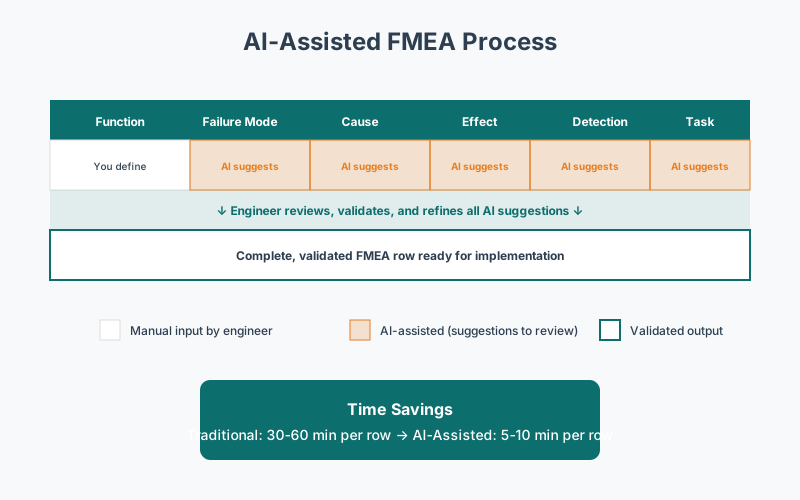
The Traditional FMEA Challenge
A typical FMEA row requires:- •Function being analysed
- •Functional failure (loss of function)
- •Failure mode (how it fails)
- •Failure cause (why it fails)
- •Local effect (immediate consequence)
- •System effect (broader impact)
- •End effect (ultimate consequence)
- •Detection method (how we'd find it)
- •Recommended task (what to do about it)
Step 1: Define the Equipment Clearly
Before involving AI, document:
Equipment identification:- •Full name and tag number
- •Equipment type (be specific)
- •Manufacturer and model if relevant
- •What does it do in your process?
- •How critical is it? (redundancy, consequences)
- •Operating environment (temperature, humidity, contaminants)
- •Duty cycle (continuous, intermittent, standby)
- •Key parameters (flow, pressure, temperature, speed)
- •Acceptable tolerances
- •Required availability
Step 2: Generate Functions
Use our Function Statement Generator or craft prompts manually.
Good function statement structure:
To [verb] [noun] [performance standard] Examples:- •To transfer cooling water at 500 m³/h minimum
- •To maintain discharge pressure at 4 bar or greater
- •To contain pumped fluid with no visible external leakage
AI prompt example:
Generate RCM function statements for a centrifugal cooling water pump (P-101A). Primary purpose: transfer cooling water from basin to heat exchangers. Required flow: 500 m³/h. Required pressure: 4 bar. Operates 24/7. Include primary and secondary functions.
Review checklist:
- •[ ] All primary functions captured?
- •[ ] Secondary functions included (safety, containment, environmental)?
- •[ ] Performance standards are measurable?
- •[ ] Standards match actual requirements, not nameplate?
Step 3: Identify Failure Modes
This is where AI really helps. Use our Failure Mode Suggester or similar tools.
For each function, identify:
- •Functional failures (ways the function can be lost or degraded)
- •Failure modes (specific mechanisms causing each functional failure)
AI assistance approach:
- 1.Start broad: Get AI to suggest all possible failure modes for the equipment type
- 2.Filter by context: Remove modes that aren't credible in your specific situation
- 3.Add from experience: Include failure modes you've seen that AI missed
- 4.Verify technical accuracy: Don't trust AI claims without validation
Common filtering questions:
- •Has this failure mode occurred on similar equipment in our facility?
- •Is this failure mode possible given our operating conditions?
- •Is this failure mode significant enough to analyse?
Step 4: Document Effects
For each failure mode, AI can help draft:
Local Effect
The immediate, observable consequence at the equipment AI prompt: "What are the immediate local effects when [failure mode] occurs on [equipment type]?"System Effect
The broader impact on the system or process AI prompt: "What system-level effects result from [failure mode] on [equipment] in a [process type] system?"End Effect
The ultimate consequence (safety, environmental, operational, cost) AI prompt: "What are the end effects and consequences of [failure mode] on [equipment] if left unaddressed?"Review tips:
- •Ensure effects are specific to your context
- •Verify safety and environmental consequences are accurate
- •Check that end effects align with your consequence classification
Step 5: Classify Consequences
Use our Consequence Classifier to walk through the RCM decision logic:- 1.Is the failure evident? (Hidden vs Evident)
- 2.Does it affect safety?
- 3.Does it affect environment?
- 4.Does it affect operations?
Step 6: Determine Detection and Tasks
Detection Methods
AI can suggest monitoring techniques based on failure mode type:- •Vibration analysis for bearing failures
- •Temperature monitoring for overheating
- •Oil analysis for wear
- •Visual inspection for leaks
- •Performance monitoring for degradation
Task Selection
Based on consequence category: Safety/Environmental consequences:- •Must find an effective proactive task
- •If none exists, redesign is mandatory
- •Proactive task must be cost-justified
- •Run-to-failure acceptable if cheaper
- •Proactive task only if cheaper than failure
- •Run-to-failure often optimal
Complete Workflow Example
Equipment: Cooling Water Pump P-101A Step 1 - Context:- •Centrifugal pump, 500 m³/h, 4 bar
- •Supplies cooling water to critical heat exchangers
- •No installed spare, 2-hour impact on production if failed
- 1.Transfer cooling water at 500 m³/h minimum
- 2.Maintain discharge pressure at 4 bar
- 3.Contain pumped fluid with no external leakage
- 4.Start on demand within 30 seconds
- •Bearing: Worn due to fatigue
- •Bearing: Failed due to lubrication loss
- •Seal: Leaking due to wear
- •Impeller: Eroded due to cavitation
| Mode | Local | System | End |
|---|---|---|---|
| Bearing worn | Vibration, noise | Pump efficiency reduced | Production impact, repair cost |
| Seal leaking | External drip | Water loss, slip hazard | Minor cleanup, seal replacement |
- •Bearing failure: Operational (affects production)
- •Seal leak: Non-operational (repair cost only)
- •Bearing: Vibration monitoring monthly (P-F = 2-8 weeks)
- •Seal: Visual inspection weekly
Quality Assurance
After AI assistance, verify:- •[ ] All failure modes are technically accurate
- •[ ] Effects are specific to your context
- •[ ] Consequence classifications are correct
- •[ ] Task intervals match P-F intervals (task ≤ P-F/2)
- •[ ] Nothing critical was missed
Time Savings
| Activity | Traditional | AI-Assisted |
|---|---|---|
| Function statements | 15-30 min | 5-10 min |
| Failure mode identification | 30-60 min | 10-15 min |
| Effects documentation | 20-40 min | 10-15 min |
| Total per equipment | 1-2 hours | 25-40 min |
Tools Summary
Use these free tools for your AI-assisted FMEA:- 1.Function Statement Generator — Step 2
- 2.Failure Mode Suggester — Step 3
- 3.FMEA Row Helper — Steps 4-5
- 4.Consequence Classifier — Step 5
- 5.P-F Interval Estimator — Step 6
- 6.RCM Analysis Wizard — Complete workflow
Conclusion
AI-assisted FMEA isn't about replacing engineering judgment—it's about eliminating the tedious drafting work so you can focus on what matters: making good decisions about your equipment.
The key principles:- •AI drafts, you decide
- •Context is everything
- •Always validate AI output
- •Use the time savings for better analysis, not just faster analysis
Try the complete workflow with our RCM Analysis Wizard—it guides you through every step.
Ready to Improve Your Maintenance Programme?
Our professionally designed RCM templates and tools help you implement reliability best practices efficiently.

Dr. Anya Sharma
Reliability Data Scientist
Anya applies data science and AI to practical reliability problems. She helps shape Reliability HQ’s AI-powered tools so they stay grounded in robust analysis, realistic assumptions, and measurable outcomes.